
If you feel like your skin has quietly lost its glow and smoothness over the past few years, you are not alone. It is one of the most common concerns patients bring to us in Highlands Ranch.
Skin is a living, regenerating organ. Therapies like microneedling with PRP are designed to work alongside your body’s own repair process rather than override it.
Understanding how that process actually works makes it much easier to decide whether it belongs in your plan.
This article is for educational purposes only and is not medical advice or a diagnosis. Therapy decisions should always be made with a qualified healthcare provider.
What Microneedling With PRP Actually Is
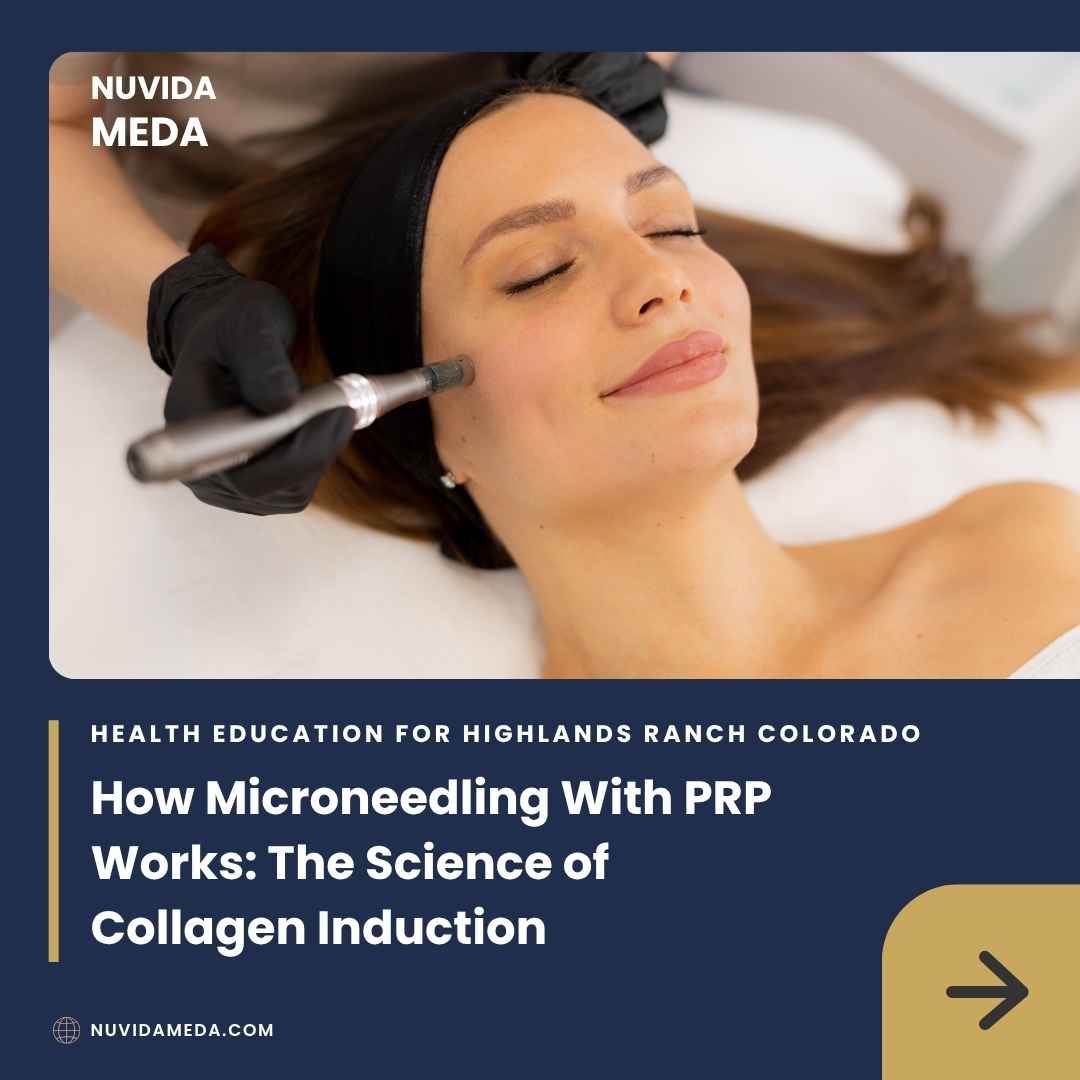
Microneedling uses a medical device with very fine, sterile needles to create controlled micro-channels in the upper layers of the skin.
These channels are small and intentional. They are not injuries in the way a scrape or a cut is an injury.
PRP stands for platelet-rich plasma. It is prepared from a small sample of your own blood, spun in a centrifuge to concentrate the platelets and the growth factors they carry.
Pairing the two means the skin’s repair response is prompted mechanically and then supported with a concentrate drawn from your own body:
- The device creates micro-channels that signal the skin to begin its normal repair sequence
- Those channels may also allow topically applied PRP to reach beyond the surface layer
- Platelets carry growth factors that participate in ordinary tissue healing
- Because PRP is autologous, meaning it comes from you, reaction to the material itself is not a typical concern
- Needle depth, passes, and technique are adjusted to the area being treated and to your skin
The Science of Collagen Induction
Microneedling is often described as collagen induction therapy, and that phrase captures the goal well.
The aim is not to remove skin. The aim is to prompt skin to rebuild.
Phase one: the signal
When the micro-channels form, the skin registers a controlled disruption and begins its standard wound-healing sequence.
Blood flow to the area increases briefly, and repair cells are recruited to the site.
Phase two: the growth factor cascade
Platelets release growth factors that are involved in signaling fibroblasts, the cells responsible for producing collagen and elastin.
This is the stage where adding PRP is thought to matter most, because it may help support an environment already rich in the body’s own healing signals. Research in this area continues, and studies suggest results vary from person to person.
Phase three: remodeling
New collagen is not laid down neatly overnight. Over the following weeks, the skin gradually reorganizes that new tissue.
This is why changes in texture and firmness tend to appear slowly rather than all at once.
What Microneedling With PRP May Help Support
Because the mechanism is about rebuilding structure, the concerns people bring to this therapy tend to cluster around texture and tone:
- Fine lines and early crepiness, particularly around the cheeks and under-eye area
- Uneven skin texture and enlarged-looking pores
- Certain types of acne scarring, especially rolling or shallow boxcar scars
- Overall dullness in skin that has taken years of Colorado sun and dry air
- Loss of firmness associated with the natural decline in collagen production over time
Outcomes are individual. Many patients report gradual improvement in texture over a series of sessions, while some see less change than they hoped for, and results vary based on skin type, age, health history, and how consistently a plan is followed.
No therapy stops aging, and no honest clinic will tell you otherwise.
What a Session Generally Involves
Most people are surprised by how straightforward the appointment is.
A typical visit for microneedling with PRP at NuVida Medical and Aesthetics tends to follow a familiar rhythm:
- A short review of your goals, skin history, medications, and any recent therapies
- A small blood draw, which is then processed to separate the platelet-rich plasma
- Cleansing of the therapy area and application of a topical numbing agent
- The microneedling pass itself, with PRP applied during and after the therapy
- Aftercare instructions covering sun protection, skincare, and what to avoid for a few days
Redness in the hours afterward is common and usually described as similar to a mild sunburn.
If you want a broader look at how this therapy fits alongside hormonal and age-related skin changes, our earlier article on microneedling and PRP as a strategy for age-related skin changes is a useful companion read.
Why Timeline Expectations Matter So Much
Collagen remodeling is slow biology. That is not a limitation of the therapy; it is how tissue repair works.
Patients who understand the timeline going in tend to be far happier with the process:
- The first days are about calm, healing skin, not visible change
- Early smoothness or brightness in the first weeks often reflects surface healing
- Structural changes from new collagen develop gradually over subsequent months
- Most plans involve a series of sessions rather than a single visit
- Sun protection between sessions is not optional, particularly at Colorado altitude
Why Physician-Led Care Matters
Skin concerns are rarely only skin concerns. Hormones, thyroid function, blood sugar, nutrition, medications, and stress all show up on the face.
That is the difference a physician-led practice is meant to make:
- Listening first, so the plan responds to your actual concern rather than a menu item
- Reviewing your full health history, including medications and prior therapies
- Ordering laboratory work when clinically appropriate, if an underlying factor may be contributing
- Building a personalized plan with a realistic number of sessions and a realistic timeline
- Monitoring your response over time and adjusting rather than repeating on autopilot
Regenerative approaches have moved quickly in recent years, and our overview of exosomes and short chain amino acids in regenerative medicine covers where some of this science may be heading.
Is Microneedling With PRP Right for You?
The honest answer is that it depends on your skin, your goals, your health history, and your timeline.
Some patients are better served by starting elsewhere, and a good consultation should be willing to say so.
Whether microneedling with PRP belongs in your plan is a question to work through with a provider who has examined your skin and understands your history, not something to decide from an article or a social media post.
Schedule Your Consultation
If your skin no longer reflects how you feel, a conversation is a reasonable place to start. Our team in Highlands Ranch, Colorado serves patients throughout Lone Tree, Greenwood Village, and Littleton, and we are happy to walk you through your options without pressure.
Schedule your consultation with NuVida Medical and Aesthetics.