
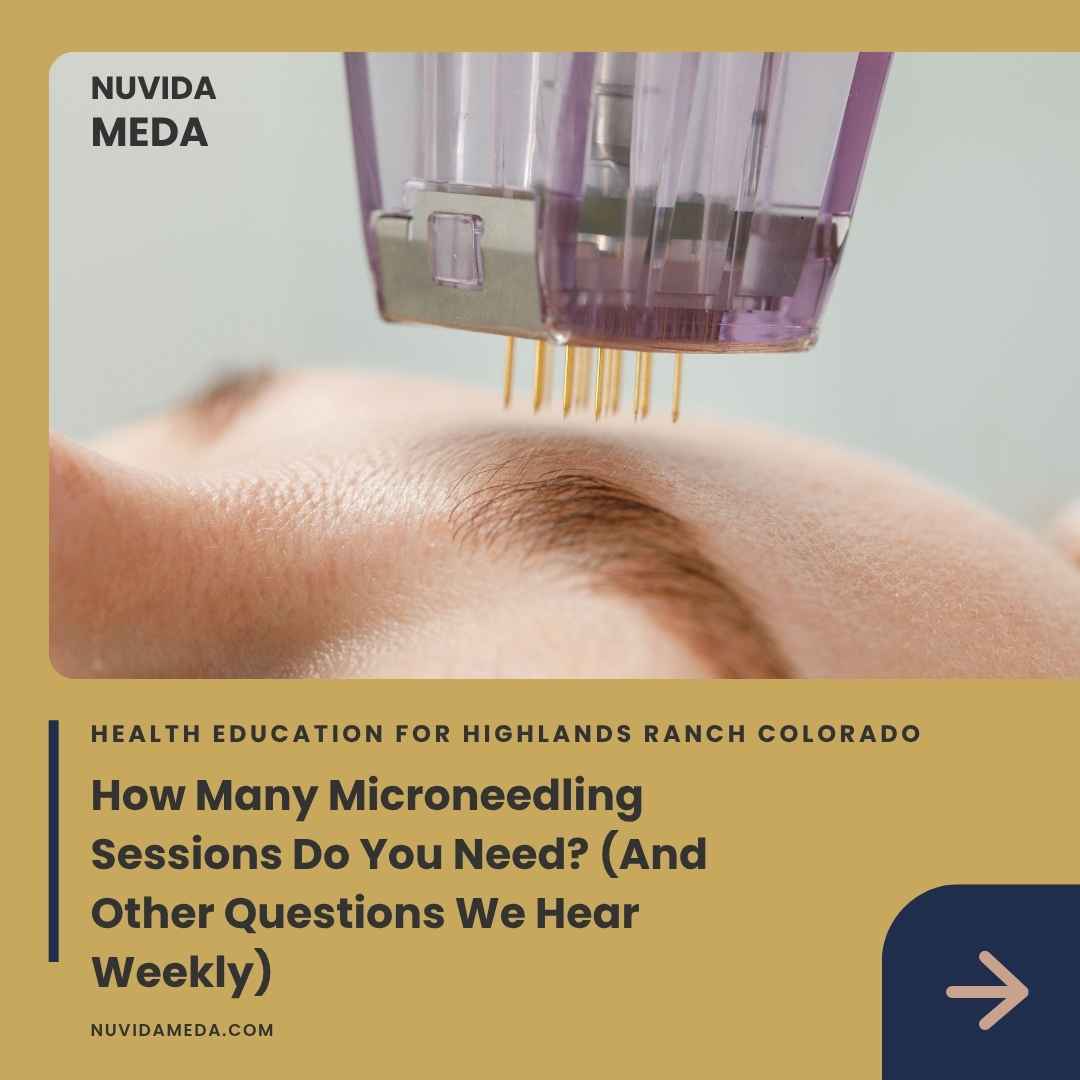
If you have been researching microneedling and still cannot get a straight answer about how many sessions you need, you are not alone. It is the single most common question we hear.
The reason it is hard to answer in a headline is that the honest answer depends on you.
Below are the questions patients in Highlands Ranch actually ask us about microneedling with PRP, answered as plainly as we can.
This article is for educational purposes only and is not medical advice or a diagnosis. Therapy decisions should always be made with a qualified healthcare provider.
How Many Microneedling Sessions Do You Need?
Microneedling is almost always planned as a series rather than a one-time therapy.
That is because collagen remodeling is gradual biology, and each session builds on the last.
The number your provider recommends generally depends on:
- What you are treating, since texture, fine lines, and scarring respond differently
- How long the concern has been present and how established it is
- Your age, skin type, and general health, all of which influence healing
- How your skin responds to the first sessions, which is real information worth acting on
- Whether the plan includes PRP, other therapies, or supportive skincare
Any clinic that quotes you a session count before examining your skin is guessing.
How Far Apart Should Sessions Be?
Sessions are spaced to let the skin complete a meaningful portion of its repair cycle before it is prompted again.
Rushing the interval does not accelerate collagen production. It mostly adds irritation.
When Will I See Results?
Two different things happen on two different timelines, and confusing them causes most of the disappointment we see:
- Short term: surface healing, hydration, and a temporary plumping effect in the first week or two
- Longer term: structural change from new collagen, which develops over months, not days
- Cumulative: many patients report that the difference is clearest when comparing photos across a full series
Results vary from person to person, and outcomes are individual.
Does It Hurt?
Topical numbing is applied before therapy and usually sits for twenty to thirty minutes.
Most patients describe the sensation as prickly, vibrating, or sandpaper-like rather than sharp. Bonier areas like the forehead tend to be more noticeable than the cheeks.
What Is the Downtime?
Redness on the day of therapy is expected and is often compared to a mild sunburn.
Common aftercare guidance includes:
- Keeping the skin clean and simple for the first day or two
- Pausing retinoids, acids, and exfoliants until your provider clears them
- Avoiding heavy sweating, saunas, and hot tubs for a short period
- Protecting your skin from sun, which matters especially at Colorado altitude
- Calling the office if anything looks or feels unexpected rather than waiting it out
Why Add PRP At All?
PRP is platelet-rich plasma prepared from a small sample of your own blood.
The reasoning is that the growth factors platelets carry participate in normal tissue repair, so applying that concentrate to freshly treated skin may help support the healing environment. Studies suggest benefit for some patients, though findings vary and research continues.
We walk through that mechanism in detail in how microneedling with PRP works.
Am I a Candidate?
This is a question for an examination, not an article. We cannot tell you from here, and neither can anyone else online.
Factors a provider will want to know about include:
- Active skin infections, significant inflammation, or open lesions in the therapy area
- Bleeding or clotting conditions and blood-thinning medications
- Autoimmune conditions or immune-modulating therapy
- Pregnancy or breastfeeding
- A history of keloid or hypertrophic scarring
- Recent isotretinoin use, resurfacing procedures, or significant sun exposure
You can see how we approach this on our microneedling with PRP service page.
Can I Combine It With Other Therapies?
Often, yes, when clinically appropriate and properly sequenced.
Sequencing matters more than people expect, because stacking therapies too closely can leave skin irritated without adding benefit.
PRP is used in other contexts as well. Our overview of hair loss solutions for men and women covers one of them.
Why Physician-Led Care Matters
Most of the questions above have the same underlying answer: it depends on your particular situation, and someone qualified needs to look.
In a physician-led practice, that means:
- Listening to your concern before recommending a therapy
- Reviewing your health history and current medications
- Ordering laboratory work when clinically appropriate
- Building a personalized plan with realistic expectations attached
- Monitoring your response over time and adjusting the plan as needed
Still Wondering About Microneedling With PRP?
If your question was not covered here, that is a good reason to ask it in person.
The right number of microneedling with PRP sessions for you is something a provider determines with your skin in front of them, your history in hand, and your goals on the table.
Schedule Your Consultation
We see patients from Highlands Ranch, Lone Tree, Greenwood Village, and Littleton, and we are glad to answer your questions without any pressure to book a therapy. You can reach our Colorado office at (720) 417-3460.
Schedule your consultation with NuVida Medical and Aesthetics.