
If you keep hearing about exosomes and still are not sure what they actually are, you are not alone. The term has moved from research journals to social media almost overnight.
Some of what you read is careful and accurate. Some of it is marketing that gets well ahead of the evidence.
This guide explains exosome therapy in plain language: what exosomes are, how they work in the body, what the research currently suggests, and what questions are worth asking before you consider therapy here in Highlands Ranch.
This article is for educational purposes only and is not medical advice or a diagnosis. Therapy decisions should always be made with a qualified healthcare provider.
What Exosomes Actually Are
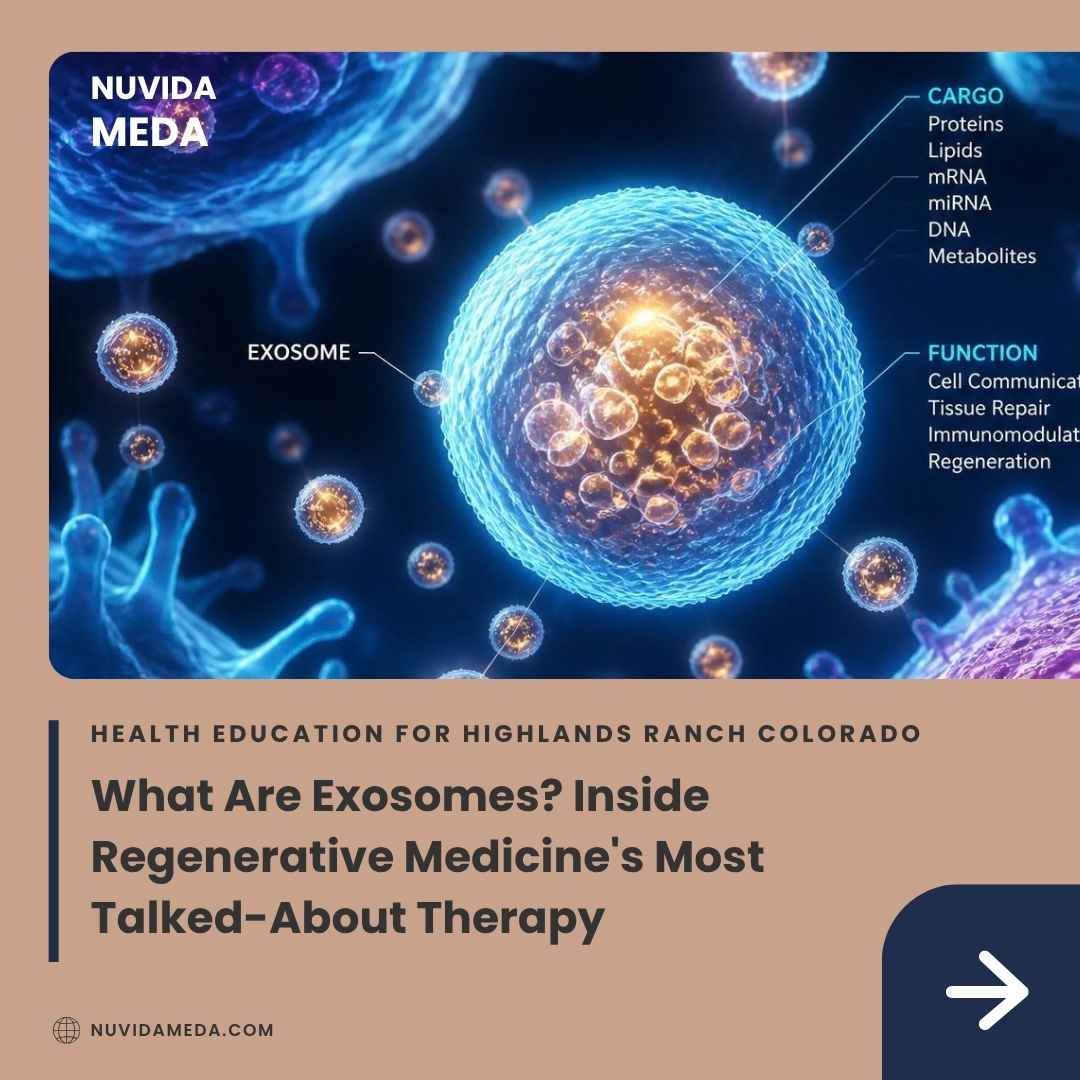
Exosomes are tiny particles released by cells. They are far smaller than a cell itself and cannot be seen without specialized equipment.
Think of them as envelopes. Cells pack them with molecular information and send them out to neighboring cells.
What Is Inside the Envelope
Researchers have found that exosomes can carry a mix of biological cargo, including:
- Proteins, including growth factors
- Lipids that make up the particle’s outer layer
- Genetic signaling molecules such as microRNA
- Other molecules that may influence how the receiving cell behaves
Why Cells Send Them
Exosomes are part of how cells communicate. When tissue is stressed or injured, cells exchange signals that help coordinate the response.
That communication role is exactly why exosomes have drawn so much interest in regenerative medicine.
Why Regenerative Medicine Is Paying Attention
For years, regenerative research focused on cells themselves. More recently, attention has shifted toward the signals those cells send.
The Signal, Not the Cell
Studies suggest that much of the benefit once attributed to certain cells may come from the signaling molecules they release. Exosomes are one of the main ways those signals travel.
That idea has led researchers to ask whether the signals alone might support tissue repair without introducing living cells.
Where Early Research Is Focused
Exosome research spans many fields. In aesthetic and wellness medicine, interest tends to center on:
- Skin recovery after procedures such as microneedling
- Skin texture, tone, and signs of aging
- Support for thinning hair and the scalp environment
- Inflammation and the body’s natural healing signals
Much of this work is still early. Many studies are small, and the long-term picture is still being written.
What the Research Does and Does Not Tell Us
Honesty matters here, because this is a field where excitement can outpace evidence.
What Is Encouraging
Laboratory and early clinical studies suggest exosomes may help support healing signals in skin and hair follicles. Many patients report a smoother recovery when exosomes are used alongside procedures like microneedling.
What Is Still Uncertain
There are open questions that any responsible provider should be willing to discuss:
- Products vary widely in source, processing, and quality
- Large, long-term human studies are still limited
- Ideal dosing and frequency are not yet standardized
- Exosome products are not FDA-approved to treat any disease or condition
That last point is important. Be cautious of anyone promising that exosomes will cure a condition or deliver a specific result.
Common Myths About Exosomes
Because exosomes are new to most people, a few misunderstandings come up again and again in our Highlands Ranch office.
Myth: Exosomes Are the Same as Stem Cells
Exosomes are released by cells, but they are not cells. They cannot divide, multiply, or turn into other kinds of tissue. They carry signals, and that is all.
Myth: More Is Always Better
There is no evidence that a larger amount or more frequent sessions automatically produce better outcomes. Dosing is still being studied, which is one reason a physician should guide the plan.
Myth: Exosomes Replace Everything Else
Exosomes are usually a supporting step, not a replacement for sun protection, good skin care, or addressing underlying causes such as hormone shifts or nutritional gaps.
How Exosome Therapy Is Typically Used in Aesthetic Care
In most aesthetic practices, exosomes are used as a supporting step rather than a stand-alone therapy.
Paired With Microneedling
Microneedling creates tiny channels in the skin that trigger a natural repair response. Exosomes are often applied topically afterward, when clinically appropriate, with the goal of supporting that recovery.
If you are curious about the repair process itself, our post on collagen induction walks through it step by step.
As Part of a Scalp Plan
For thinning hair, exosomes may be considered as one piece of a broader plan that also looks at hormones, nutrition, and other contributing factors.
Alongside Short Chain Amino Acids and Wellness Care
Exosomes and short chain amino acids are often discussed together because both involve biological signaling. They are different tools, though, and they are not interchangeable. Our exosome therapy page explains how we approach both.
Questions to Ask Before Considering Exosomes
Because the market is still young, the questions you ask matter as much as the therapy itself:
- Where does the exosome product come from, and how is it processed?
- Who is evaluating whether I am a good candidate?
- What realistic outcomes should I expect, and over what timeline?
- What are the possible side effects or reasons to wait?
- Are there other options that may suit my goals better?
A provider who welcomes these questions is usually a good sign.
Why Physician-Led Care Matters
Emerging therapies deserve more oversight, not less. A physician-led approach means:
- Listening to your goals and frustrations first
- Reviewing your health history, medications, and skin or scalp concerns
- Ordering labs when appropriate, especially for hair thinning
- Building a personalized plan rather than selling a single product
- Monitoring your progress and adjusting over time
Colorado’s dry air, strong sun, and altitude also shape how skin behaves, which is one more reason a local, individualized plan matters. Our overview of exosomes and short chain amino acids offers more background.
The Bottom Line on Exosome Therapy
Exosomes are a genuinely interesting area of regenerative medicine. They may help support the body’s own repair signals, particularly when paired with therapies like microneedling.
They are also still being studied, and results vary from person to person. The right next step is a conversation, not a purchase.
Schedule Your Consultation
If you have been wondering whether exosome therapy could fit your skin or hair goals, we would be glad to talk it through with you. Our team serves Highlands Ranch, Lone Tree, Greenwood Village, and Littleton.
Schedule a consultation with NuVida Medical and Aesthetics.