
If you finally got your breakouts under control only to be left with dents, shadows, and uneven texture, you are not alone.
Many patients tell us the scars bother them more than the acne ever did.
The encouraging part is that acne scars are not all one thing. Knowing which type you have is the first real step toward choosing an acne scar therapy that makes sense for your skin.
This article is for educational purposes only and is not medical advice or a diagnosis. Therapy decisions should always be made with a qualified healthcare provider.
What Actually Happens When Acne Scars Form
A scar is not a sign that you did something wrong. It is a record of how your skin healed.
The Inflammation Stage
A deep pimple, cyst, or nodule inflames the tissue around the pore, not just the surface.
When that inflammation reaches the dermis, the supportive layer where collagen lives, the structure underneath can be damaged before the spot ever clears.
The longer and deeper the inflammation runs, the more repair work your skin has to do afterward.
The Repair Stage
Your body then rebuilds, and the quality of that rebuild is what you see in the mirror years later:
- Too little collagen laid down leaves a depression or dent
- Too much collagen can leave a raised, firm area
- Pigment cells stirred up by inflammation can leave a flat brown or red mark
- Repeated flares in the same spot may compound the change
This is why two people with similar acne can end up with very different skin.
Why Some People Scar More Than Others
Scarring risk is not evenly distributed, and much of it is outside anyone’s control:
- Genetics, which strongly influence how your skin repairs itself
- How deep the original lesions were, with cysts and nodules carrying more risk
- How long acne went untreated before it was brought under control
- Picking or squeezing, which extends inflammation into deeper tissue
- Hormonal patterns that keep breakouts cycling in the same areas
If you did everything right and still scarred, that is a common story, not a personal failure.
The Main Types of Acne Scars
Most patients have a mix, which is part of why one-size-fits-all products often disappoint.
Atrophic (Depressed) Scars
These are the most common after inflammatory acne, and they generally fall into three shapes:
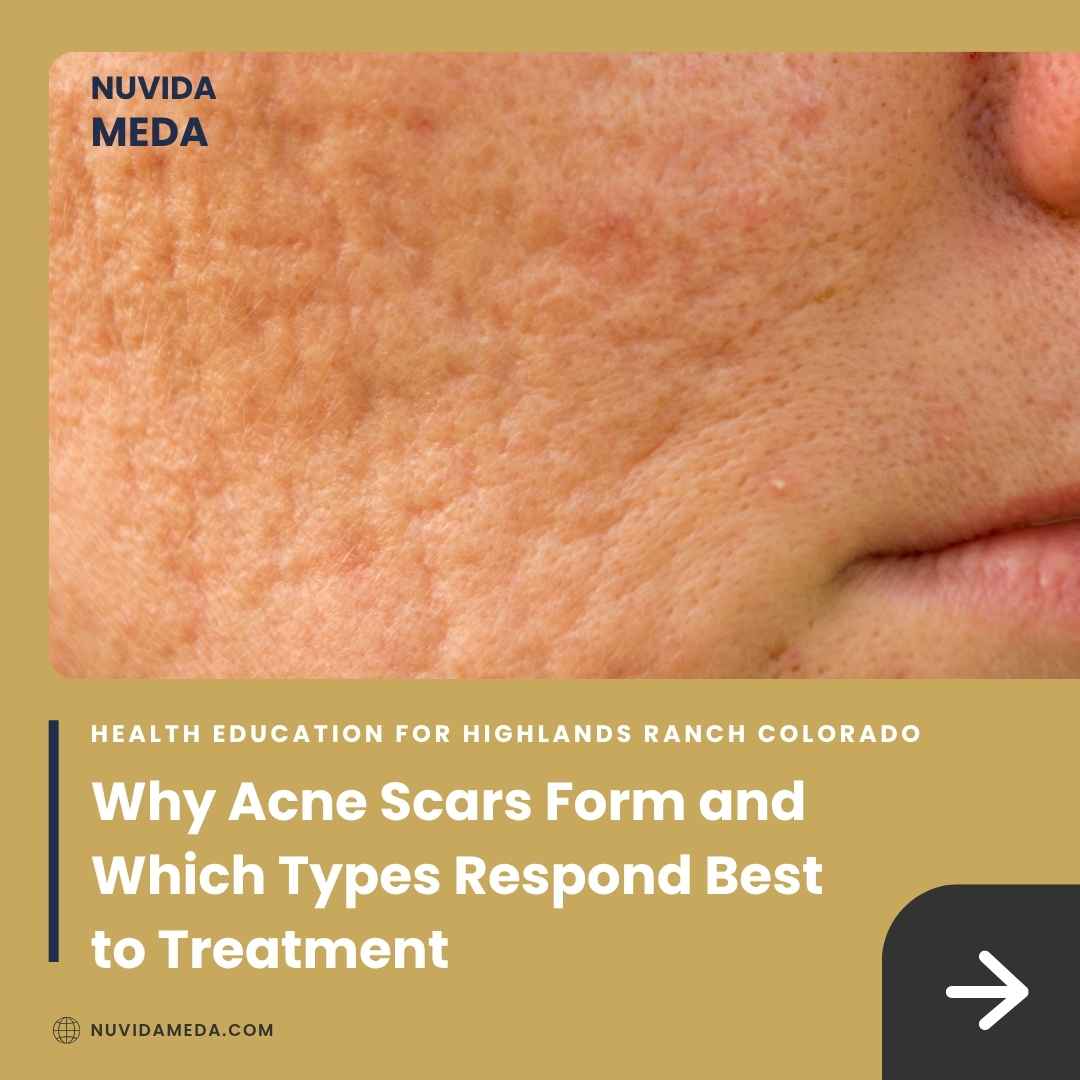
- Rolling scars: broad, soft dips that give skin a wavy look in side lighting
- Boxcar scars: wider depressions with defined edges, often on the cheeks
- Ice pick scars: small, deep, narrow pits that look like tiny punctures
Rolling scars tend to look worse in harsh overhead light. Ice pick scars often look worse up close in a mirror. Both observations are useful to bring to a consultation.
Raised and Firm Scars
Less common on the face but more frequent on the chest, shoulders, and jawline, these form when the body lays down extra collagen during healing.
They are managed very differently from depressed scars, which is one reason a clinical evaluation matters before starting anything.
Marks That Are Not True Scars
Flat red or brown spots left behind after a breakout are usually pigment changes rather than structural scars.
Many of these fade on their own over months, and they respond to a different set of tools than texture does.
A simple check at home: if the mark disappears when the light hits your face from the side, it is far more likely to be pigment than a scar.
Which Scars Respond Best to Acne Scar Therapy
No honest provider can promise a specific outcome, and results vary from person to person. That said, some patterns show up again and again in clinical practice.
Rolling and Shallow Boxcar Scars
These tend to be the most responsive to collagen-stimulating approaches, because the goal is to rebuild volume under a soft dip rather than remove a sharp edge.
Microneedling is one of the options often discussed here, and it helps to understand how microneedling works before deciding whether it fits your skin.
Deep Ice Pick Scars
Narrow, deep pits are the most stubborn category, and they often need a combination strategy rather than a single therapy.
Realistic framing here protects you: meaningful softening is a reasonable conversation; complete erasure is not.
Texture Plus Discoloration Together
When both are present, sequencing matters. Many patients are better served by addressing active inflammation and pigment first, then working on texture.
Our approach to acne scar therapy in Highlands Ranch starts with identifying that mix before anything is scheduled.
What Influences Your Results
Several factors shape what is realistic for any given patient:
- The depth and age of the scars
- Whether acne is still active or fully settled
- Your skin tone and how it tends to respond to inflammation
- Sun exposure and daily skincare habits
- Overall health, nutrition, and sleep, which affect healing
- How consistently you complete a recommended series
Notice how many of those are within your influence. Consistency between visits often matters as much as what happens during them.
The Colorado Factor
Living at altitude along the Front Range means stronger UV exposure and dry air year-round, both of which can work against healing skin.
We talk with patients across Highlands Ranch, Lone Tree, and Littleton about this constantly, and it is worth reading how Colorado’s climate affects skin over time.
Understanding the broader picture of skin aging also helps put scar work in context, since collagen loss continues regardless of acne history.
Myths Worth Setting Aside
A few beliefs come up so often that they are worth addressing directly.
“A Stronger Product Will Fix It”
Topical products work at the surface. A truly depressed scar is a structural change several layers down.
Good skincare supports results and protects your investment, but on its own it rarely changes contour.
“Scars Will Fade Eventually”
Pigment marks often do fade with time and sun protection. Structural scars generally do not.
Waiting is a reasonable choice, but it should be an informed one rather than a hope.
Why Physician-Led Care Matters
Acne scarring sits at the intersection of skin structure, inflammation, and sometimes hormones, so the evaluation should go deeper than a quick look at your face.
In a physician-led practice, that means:
- Listening first to what bothers you most and what you have already tried
- Reviewing your health history, medications, and skincare routine
- Ordering labs when clinically appropriate, including hormone or metabolic markers
- Mapping which scar types you actually have, in good lighting
- Building a personalized plan with a realistic timeline
- Monitoring how your skin responds and adjusting rather than repeating blindly
That last point matters. Skin gives feedback, and a plan that never changes is not really a plan.
It also means being told when the answer is to wait, or when a different concern should be addressed first.
Schedule Your Consultation
If your scars have been on your mind for years, a straightforward conversation with a physician-led team is a reasonable next step.
We will look at what you have, explain what may help, and tell you honestly what is unlikely to change.
Schedule your consultation with NuVida Medical and Aesthetics.