

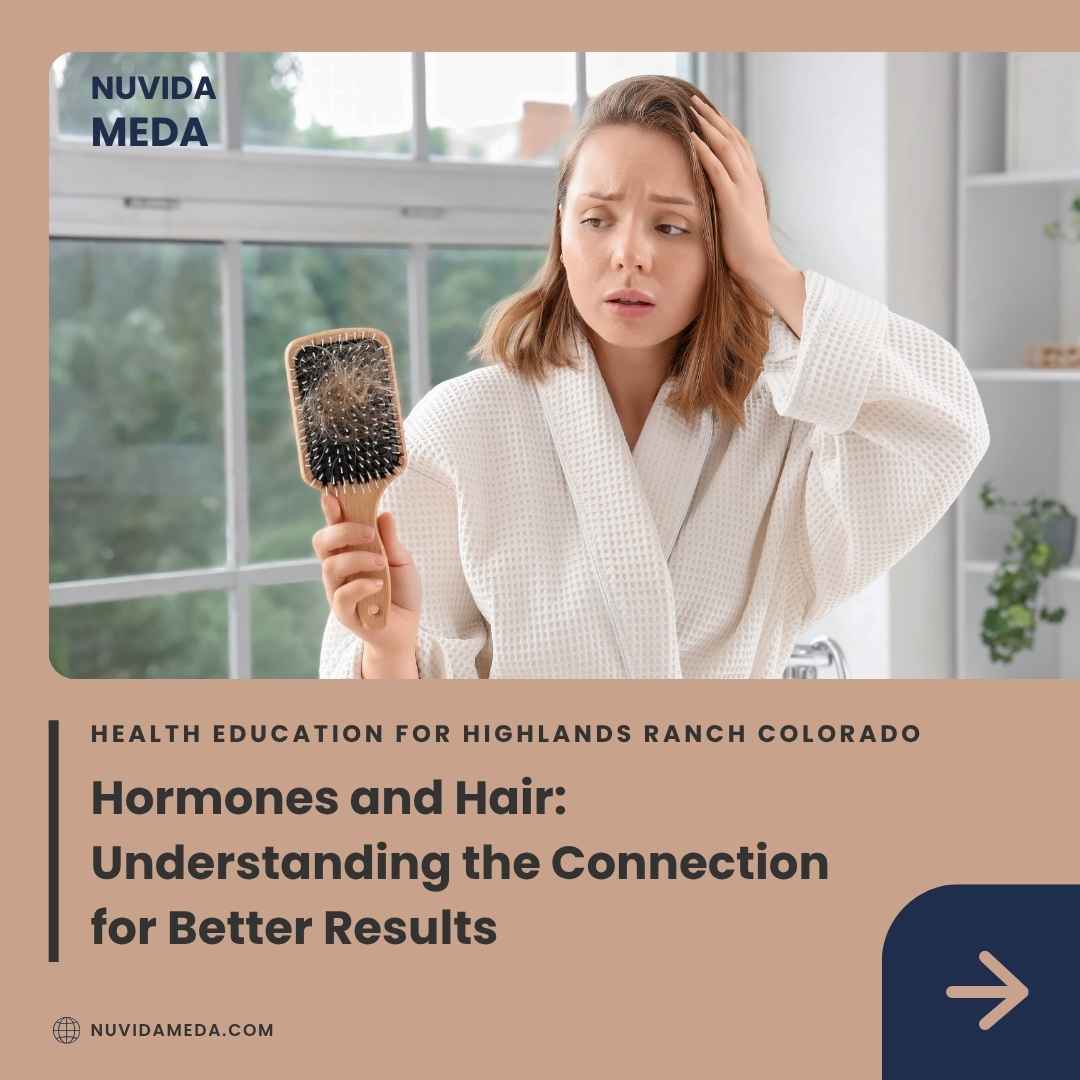
If your hair started changing around the same time your sleep, energy, or cycle did, you are not alone.
That overlap is one of the most common patterns we see, and it is also one of the most commonly missed.
Hormonal hair loss is not a separate condition so much as a reminder that the follicle is a hormonally sensitive tissue, and it responds to what is happening everywhere else in your body.
This article is for educational purposes only and is not medical advice or a diagnosis. Therapy decisions should always be made with a qualified healthcare provider.
Why Hair Is a Hormonally Sensitive Tissue
Each follicle has receptors that respond to circulating hormones, which act as signals for how long to keep growing.
Shorten the growth phase, and the hair that emerges is finer and shorter than the one it replaced.
Repeat that over a few cycles, and the result reads as thinning, even though you have not technically lost follicles. Our explainer on the follicle cycle covers that mechanism in more detail.
The Hormones Most Often Involved
Rarely is only one of these at play. In most of the patients we evaluate, two or three are moving at once.
Thyroid Hormone
Thyroid hormone helps set the pace of cell turnover, and hair is a fast-turnover tissue.
Both an underactive and an overactive thyroid can show up as diffuse thinning, often alongside fatigue, dry skin, or temperature sensitivity.
Estrogen and Progesterone
Estrogen tends to favor a longer growth phase, which is part of why postpartum and perimenopausal shifts are so often felt in the hair.
Many women first notice a widening part in their forties, around the same time cycles and sleep start changing.
We look at that question specifically in HRT and hair loss.
Testosterone and DHT Sensitivity
Pattern hair loss in both men and women is largely about how sensitive your follicles are to a testosterone byproduct, not simply about how much testosterone you have.
That is why two people with similar labs can have very different hairlines, and why a lab value alone never tells the whole story.
Cortisol and Chronic Stress
Sustained stress can push a large share of follicles into the resting phase at once.
The shedding usually shows up two to three months after the stressful stretch, long after most people have stopped connecting the two.
Insulin and Metabolic Health
Insulin resistance travels with hormonal change, and it can influence circulation and androgen activity at the follicle.
This is one reason we look at metabolic markers in people whose thinning does not have an obvious cause.
Why Scalp-Only Therapy Often Stalls
Here is the part that explains a lot of frustration.
If the signal telling your follicles to shorten their growth phase is still being sent, a topical is working against a headwind.
You may see some improvement, then plateau, then conclude the therapy failed when the real issue was never addressed.
This is also why people sometimes get better results in their second round of therapy than their first: by then, the underlying driver has been found.
What a Combined Hormonal Hair Loss Plan Looks Like
When testing points to a hormonal contributor, the plan usually works on two levels at once:
- Supporting the hormonal picture through hormone optimization, when clinically appropriate
- Treating the scalp directly through our hair restoration program
- Correcting iron, vitamin D, or protein gaps found on labs
- Addressing sleep and stress, which are not optional extras here
- Repeating labs to confirm the change actually happened
- Tracking the scalp with standardized photos over several months
Many patients report that the energy and sleep changes arrive before the hair changes, which can be a useful early signal.
Results vary, and hormonal support is not appropriate for everyone. That decision belongs in a consultation, not an article.
Why Physician-Led Care Matters With Hormones
Hormones affect far more than hair, so they deserve more care than a single number on a panel. In practice, that means:
- Listening to the full symptom picture, not just the scalp complaint
- Reviewing health history, medications, and family patterns
- Ordering appropriate labs and interpreting them in context
- Building a personalized plan rather than a standard protocol
- Monitoring over time and adjusting as labs and symptoms change
- Being candid when hormones are not the explanation
If you want to know which labs are worth asking for, our article on which hormones to test is a practical place to start.
Take the Next Step
If your hair changed alongside your energy, sleep, mood, or cycle, those things are worth looking at together rather than separately.
We see patients from Highlands Ranch, Lone Tree, Greenwood Village, and Littleton, and we will be honest with you about what the testing shows.
Call (720) 417-3460 or schedule your consultation with NuVida Medical and Aesthetics.