

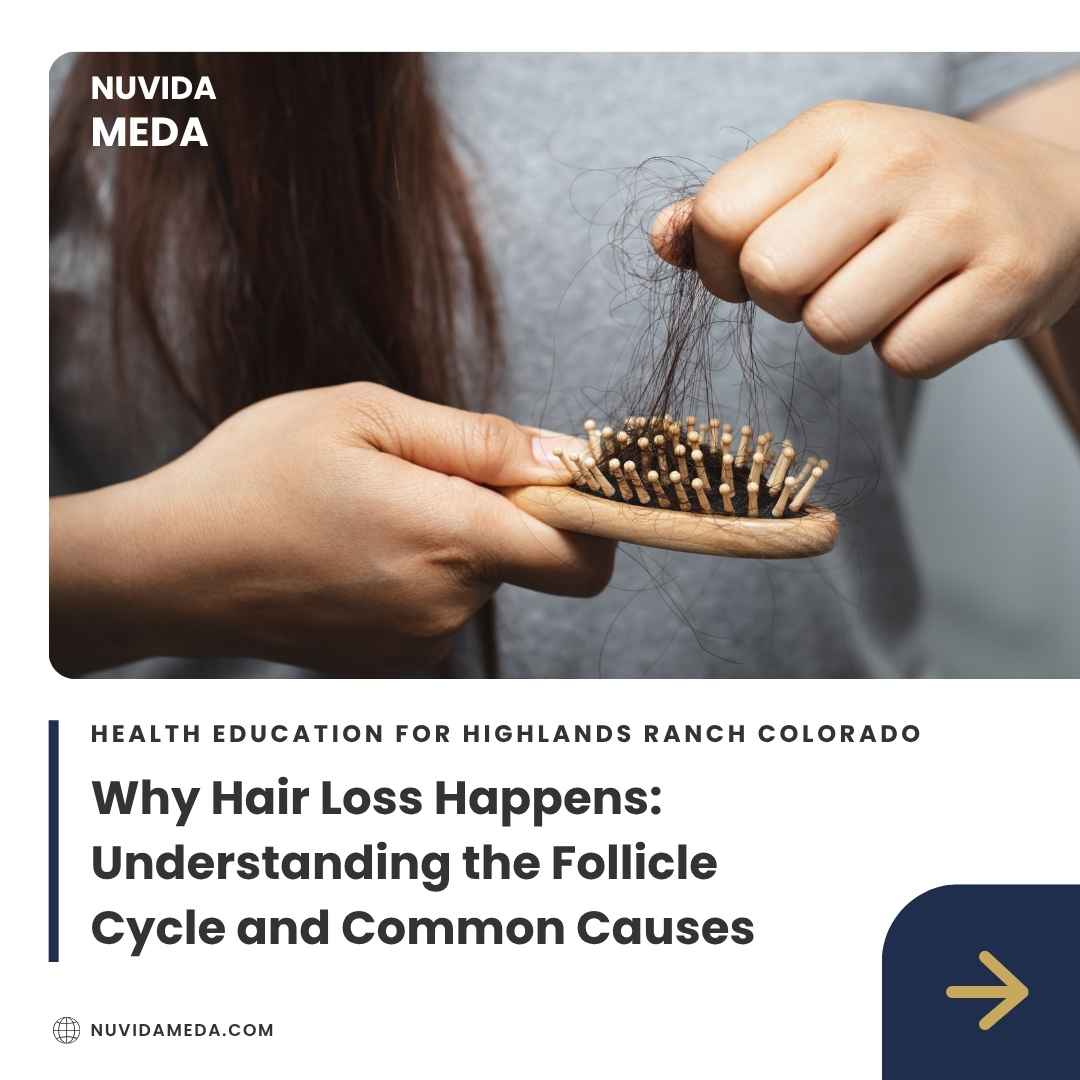
If you feel like you are losing more hair than you used to and no one has given you a straight answer about why, you are not alone.
It is one of the most common concerns we hear in our Highlands Ranch office, from women in their thirties and men in their fifties alike.
Understanding why hair thins is the first real step toward hair restoration that is built on your biology rather than guesswork.
This article is for educational purposes only and is not medical advice or a diagnosis. Therapy decisions should always be made with a qualified healthcare provider.
The Hair Growth Cycle, Explained Simply
Every follicle on your scalp runs on its own clock, independent of the ones around it.
That is why healthy hair sheds a little every day instead of falling out all at once.
When something shifts that rhythm, the change can take months to show up in the mirror.
Anagen: The Active Growth Phase
Anagen is the long stretch when a hair is actively being built from the root.
On a healthy scalp, most of your hairs are in this phase at any given moment, and it can last several years.
The longer anagen lasts, the longer and thicker a hair tends to grow before it is released.
Catagen: The Short Transition
Catagen is a brief wind-down phase that lasts a matter of weeks.
The follicle shrinks and detaches from its blood supply, and growth stops.
Telogen and Exogen: Rest and Release
In telogen, the follicle rests while the old hair stays anchored in place.
Then, in exogen, that hair is shed, and a new one begins to push up behind it.
Losing somewhere in the range of 50 to 100 hairs a day is considered normal for most adults.
What Disrupted Cycling Looks Like in Real Life
Most people do not notice a single bald patch first. They notice small changes that add up:
- A ponytail that wraps one more time than it used to
- A part line that looks wider in photos
- More hair in the shower drain or on the pillow
- Baby-fine hairs replacing the coarser ones at the temples
- Scalp showing through under bright or overhead light
- Hair that no longer reaches the length it once did
These patterns matter, because each one points toward a different part of the cycle.
Sudden, diffuse shedding usually means too many follicles entered the resting phase at once.
Gradual thinning with finer hairs usually means follicles are shrinking over time instead.
Common Causes of Hair Loss We See in Colorado
Hair loss is rarely one single thing. In most of the patients we evaluate, two or three factors overlap.
Genetic Pattern Hair Loss
This is the most common cause in both men and women, and it is driven by how sensitive your follicles are to certain hormone byproducts.
It tends to show up as a receding hairline or crown thinning in men, and as widening at the part in women.
Hormonal Change
Thyroid shifts, perimenopause, postpartum changes, and falling testosterone can all alter how long follicles stay in the growth phase.
We cover this in more depth in our article on hormones and hair loss.
Thyroid, Iron, and Nutrient Gaps
Low iron stores, low vitamin D, and under-eating protein are all common and all correctable.
Because hair is a non-essential tissue, it is often the first place the body economizes when something is short.
Stress, Illness, and Sudden Shedding
A high fever, a surgery, a crash diet, or a stretch of severe stress can push a large share of follicles into rest at the same time.
The shedding usually appears two to three months later, which is why the cause is so often missed.
Scalp Health and Colorado’s Dry Air
Living at altitude in Colorado means dry air, strong UV exposure, and a scalp that loses moisture quickly.
Chronic flaking, inflammation, or tight styling over years can add stress to follicles that are already struggling.
Why the Cause Matters More Than the Product
Most people start with a shampoo or a supplement, and that is an understandable place to begin.
The problem is that a product chosen before the cause is known may simply be aimed at the wrong mechanism.
An iron deficiency does not respond to the same approach as genetic follicle miniaturization, and neither responds well to being ignored.
If that cycle sounds familiar, our piece on hair growth supplements is worth a read.
Why Physician-Led Hair Restoration Care Matters
A physician-led evaluation is less about selling a therapy and more about narrowing down what is actually happening. In our hair restoration program, that usually means:
- Listening first, including when the shedding started and what changed around that time
- Reviewing your full health history, medications, and family patterns
- Ordering labs when clinically appropriate, rather than assuming
- Examining the scalp and the pattern of thinning directly
- Building a personalized plan that may combine more than one approach
- Monitoring over time and adjusting as your response becomes clear
Many patients report that simply having a clear explanation reduces a great deal of the anxiety.
Results vary from person to person, and no honest plan can promise a specific outcome.
What a good plan can do is work with your follicle cycle instead of against it. If you are not sure where your own thinning started, our overview of hair thinning causes is a useful next step.
When It Is Worth Getting Evaluated
Some shedding settles on its own once the trigger passes, and watchful waiting is reasonable for a season.
Other patterns tend to continue quietly until follicles are much harder to support, which is why timing matters. Consider an evaluation if you notice:
- Shedding that has continued for more than three months
- A part line or hairline that keeps widening season over season
- Thinning alongside fatigue, weight change, or cycle changes
- Patchy loss, scalp pain, burning, or visible scaling
- A family history of pattern loss starting early
Earlier is generally easier, because a follicle that is still producing hair has more to work with than one that has gone dormant.
If you are weighing what is actually available, our side-by-side breakdown compares the main options in plain language
Schedule Your Consultation
If your hair has been changing and you would rather understand it than keep guessing, a consultation is the place to start.
We see patients from Highlands Ranch, Lone Tree, Greenwood Village, and Littleton, and we will tell you honestly whether hair restoration is a reasonable fit for your situation.
Call (720) 417-3460 or schedule your consultation with NuVida Medical and Aesthetics.