

If you have started noticing more hair in the shower drain than you used to, you are not alone.
Thinning hair is one of the most common concerns patients bring to us, and it is rarely vanity that brings them in. It is the quiet frustration of watching something change that you never chose.
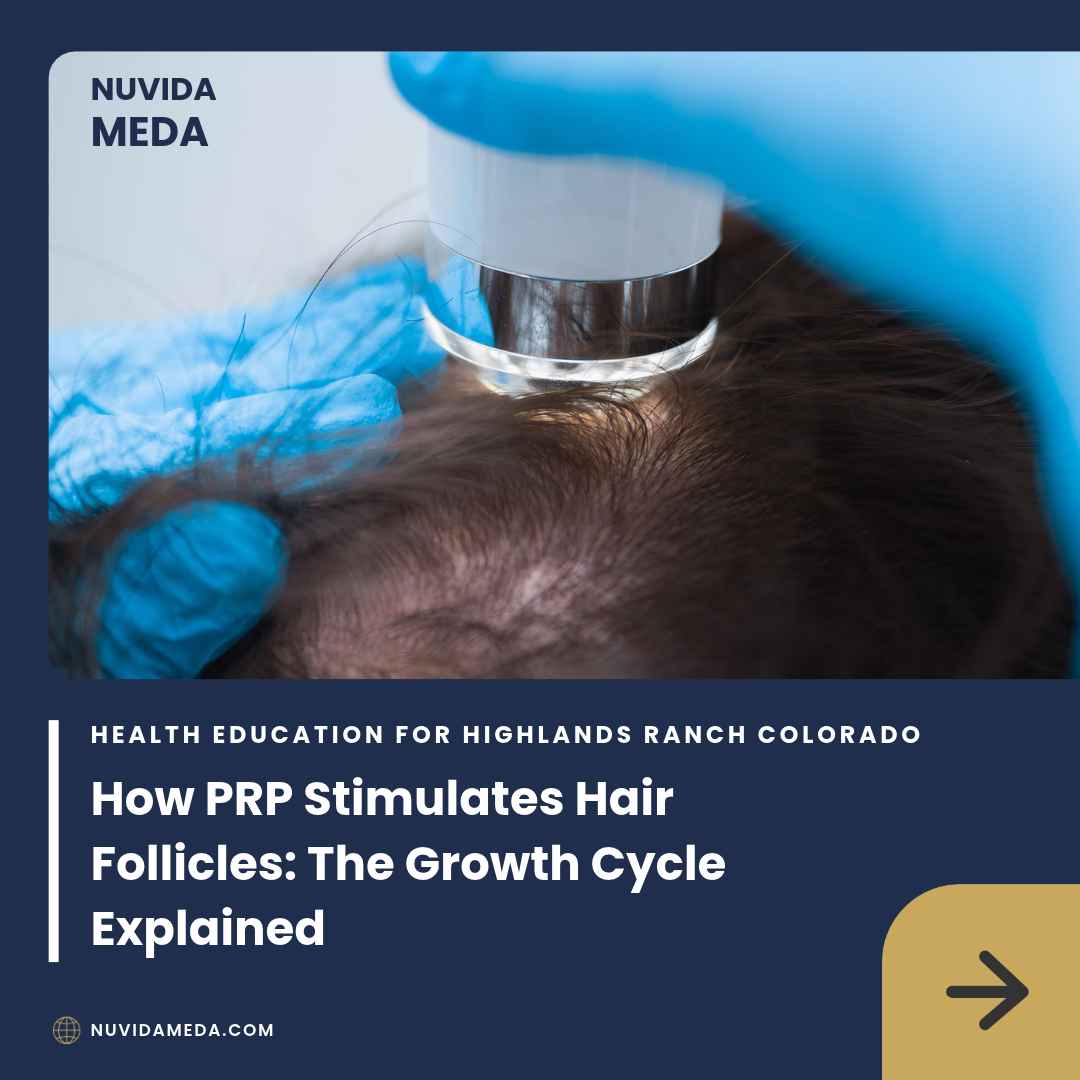
PRP hair restoration is one of the options patients across Highlands Ranch ask us about most often. The question underneath it is almost always the same: how could something drawn from your own blood help your hair?
The answer does not start with the therapy. It starts with the follicle.
This article is for educational purposes only and is not medical advice or a diagnosis. Therapy decisions should always be made with a qualified healthcare provider.
Your Hair Follicles Are Never Standing Still
Every hair on your head belongs to a follicle that works on a cycle, not a straight line.
At any given moment, the follicles on your scalp are in different phases of that cycle. That is why healthy hair sheds a little every day without ever looking thinner.
The Three Phases Every Follicle Moves Through
Dermatologists usually describe the cycle in three stages:
- Anagen (growing): the active phase, when the follicle builds hair and can last several years
- Catagen (transition): a short phase when growth slows, and the follicle begins to shrink back
- Telogen (resting): a pause before the hair releases and a new strand begins forming underneath
Healthy scalps keep the large majority of follicles in the growing phase at once.
Hair thinning usually is not a story of follicles dying. More often, it is a story of the growing phase getting shorter and the resting phase getting longer.
Why the Cycle Shifts Over Time
Several things can nudge follicles out of their growing phase early:
- Hormonal shifts, including those of perimenopause, postpartum recovery, and declining testosterone
- Genetic sensitivity to DHT, a hormone byproduct that can miniaturize follicles over years
- Thyroid conditions and iron or vitamin D insufficiency
- Significant stress, rapid weight loss, or illness
- Traction from tight styles worn consistently over time
This is also why two people with similar-looking thinning can need very different plans.
If you want a fuller look at those underlying causes, we covered them in detail in why hair loss happens.
Where PRP Hair Restoration Fits Into the Cycle
PRP stands for platelet-rich plasma, and the name describes exactly what it is.
A small volume of your blood is drawn, spun in a centrifuge to concentrate the platelets, and the resulting plasma is injected into the scalp in the areas of concern.
What Is Actually in Platelet-Rich Plasma
Platelets are best known for helping blood clot, but they carry something else that matters here: growth factors.
These are signaling proteins your body already uses for repair. Concentrating them is the whole point of the centrifuge step.
How Those Signals May Reach the Follicle
Researchers believe the growth factors in PRP may help support the follicle environment in a few ways:
- Encouraging blood vessel development around the follicle, which may improve nutrient delivery
- Supporting the cells at the base of the follicle that drive the growing phase
- Helping shift resting follicles back toward active growth when clinically appropriate
- Reducing the inflammatory signaling that can keep follicles dormant
Notice that none of this creates new follicles. PRP is studied as a way to support follicles that are still present but underperforming.
That distinction is the single most useful thing to understand before you decide whether hair restoration is a reasonable path for you.
What the Research Suggests So Far
Studies suggest that PRP may help support hair density and thickness in some patients with pattern thinning, particularly when therapy starts earlier rather than later.
The literature is still developing, and protocols vary between clinics, which makes direct comparison difficult.
What Studies Tend to Measure
When research looks at PRP for hair, the outcomes usually include:
- Hair count within a measured section of scalp
- Individual strand thickness
- The ratio of growing to resting follicles
- Patient-reported satisfaction over several months
Why Results Vary From Person to Person
Many patients report gradual change rather than a dramatic reveal, and results vary.
The factors that tend to matter most are how long the thinning has been present, whether follicles have already miniaturized, and whether anything systemic is still working against them.
Hormones sit near the top of that list, which is why we often evaluate them alongside the scalp. We walked through that overlap in hormones and hair.
Why Physician-Led Care Matters Here
Hair thinning is a symptom, not a diagnosis.
Treating the scalp without asking why the cycle shifted can mean doing good work against a headwind nobody identified.
Looking for the Cause, Not Just the Pattern
A physician-led evaluation at our Highlands Ranch practice generally includes:
- Listening to when the shedding started and how it has changed
- Reviewing your health history, medications, and family patterns
- Ordering labs when appropriate, including thyroid, iron, vitamin D, and hormone markers
- Examining the scalp and the pattern of thinning rather than guessing from photos
- Building a personalized plan and monitoring it over time instead of hoping for the best
Sometimes that evaluation points toward PRP. Sometimes it points somewhere else entirely, and that is a useful answer too.
What PRP Is Not
Being clear about limits is part of honest care:
- It does not replace follicles that are already gone
- It is not a single-visit fix, since the hair cycle itself takes months to turn over
- It is not a substitute for addressing thyroid, iron, or hormone issues
- It is not identical from clinic to clinic, because preparation and technique differ
If you are comparing regenerative options, we broke down how PRP differs from related therapies in exosomes vs. PRP.
Schedule Your Consultation
Understanding the growth cycle is what makes PRP hair restoration make sense, and it is also what makes a careful evaluation worth the time.
If your hair has been changing and you would like a physician to look at why, we would be glad to talk it through with you here in Highlands Ranch, Colorado.
Schedule your consultation with NuVida Medical and Aesthetics.